


How Boiler Equipment Company Got Carl Buddig Going Full Steam Ahead
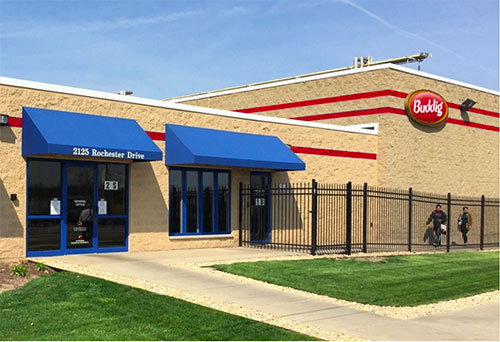 Buddig‘s newest processing facility in Montgomery, IL.
When Carl Buddig Company, a national processor of packaged lunchmeats, purchased a new facility in Montgomery, Illinois in 2017, they turned to Kevin Summers of Boiler Equipment Company (BEC) in Chicago to help them upgrade their boilers and improve the efficiency of their steam cooking operations.
BEC had worked with Buddig in the past at their Indiana plant, providing boiler repairs and upgrades. As Kevin Summers explains, “They had a couple of firetube boilers that we had serviced. And they were always having issues with their deaerator. It just wasn’t big enough so it was always going off on low water. We were trying to help them through that issue and ultimately, we ended up selling them a new, larger deaerator to handle their capacity. In the purchase of that equipment, we helped facilitate the installation, helped with startup, and guided them through the process. They were really happy with our work, so they asked us to come in and take a look at the new plant and give our opinion on what could be done at a reasonable price.”
The new plant had three existing boilers that ran the steaming operations – two 600 HP Johnston boilers and one 500 HP York Shipley boiler. All three boilers were previously-owned and had been in service since the early 2000s.
Inspection, Decisions, Challenges
In order to assess the condition of the existing boilers, BEC brought in a state inspector to examine the vessels. The inspector determined that the Johnston boilers were in need of repair. The boilers had cracked heads and leaking tubes. Additionally, the flue gas recirculation (FGR) piping on the boiler to lower the NOx level was also was leaking. These issues impacted burner efficiency and had to be addressed. The York Shipley unit required a complete replacement.
Decisions had to be made about what was worth salvaging and what had to be replaced with brand new equipment. A game plan was formed to determine what made the most sense in terms of performance and efficiency, yet was also fiscally prudent.
Summers elaborates, “We diagnosed several different issues that they (Buddig) had and decided that replacement was the most economical solution… to rip off those two Johnston burners and replace them with new burners from Webster Combustion.”
Webster’s high turndown JBE Series Gas Burner was selected, to be coupled with Siemens controls and gas-train components. An optional variable frequency drive was installed to ensure smooth turn-on/ramp-up and then slow-down/turn-off. Finally, a remote control panel was recommended to avoid vibration issues from the large, 600 HP boiler.
During the course of the Buddig boiler project, a cracked refractory was discovered when the old burner was removed. BEC gave Webster the dimensions to fabricate a new refractory mounting ring and the JBE burner was mounted onto it with ease.
Another obstacle that BEC had to overcome was to find a way to break up the boiler work into two stages so that while the Johnston 600 HP boilers were being restored, the York Shipley 500 HP boiler could remain in operation and run the steam system alone, eliminating the need to shut down the entire plant. The solution was to isolate the two 600’s from the York Shipley unit through the use of a safety valve that separated the two systems.
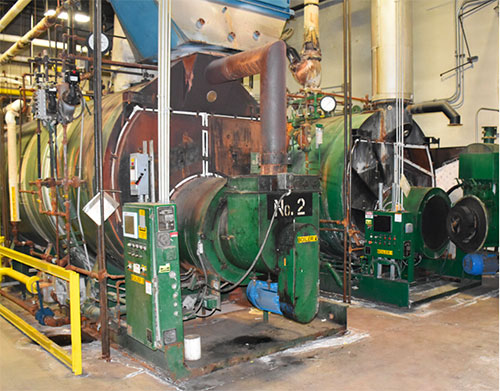
The two 600 HP Johnson boilers in Buddig’s Montgomery, IL plant BEFORE being upgraded.
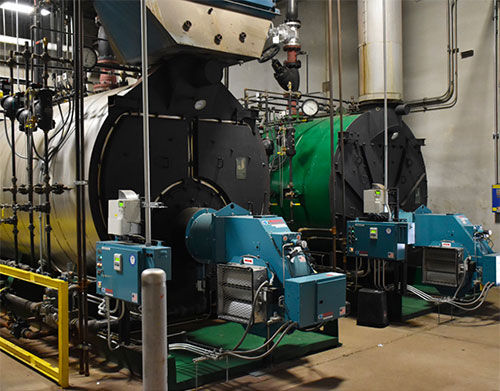
The same two boilers AFTER upgrade with Webster JBE Series burners.
Full Steam Ahead – A Race Against Time
From BEC’s initial recommendation plan to finished boiler installation and start-up took approximately 10-12 weeks (January – April 2017). BEC was working against the clock to complete the project before the next scheduled inspection. Their goal was to have the two 600 HP boilers ready to take over operations before the York Shipley was removed and replaced, so that their customer didn’t lose any production time. They succeeded, and the new Webster burners brought with them a 10:1 turndown ratio, which greatly reduced cycling (a big improvement over the 4:1 turndown ratio of the old burners).
Benefits of Working with Webster – Collaboration/Facilitation
Kevin Summers of BEC likes working with Webster for a number of reasons, not the least of which is their ability to collaborate and offer application advice. “They understand what our issues are and what the client’s issues are, and they know what burners to recommend. You can bounce different ideas off them and get a good solution out of it. There’s a whole bunch of different types of burners available for that size of boiler but what’s the most cost effective? What do you think’s going to fire the best on that particular vessel? You get a lot of different input on that sort of thing. And it’s great to bounce ideas off the guys over at Webster.”
When all was said and done, Buddig was very happy with the professionalism of BEC and how they addressed the issues, worked out the pricing, and completed the installation with virtually no shutdown in their operations.
And BEC was happy with Webster’s burner expertise and customer support. This project was a win-win situation for everyone involved.